High-crossflow impingement channels for double-wall cooling of turbomachinery blades
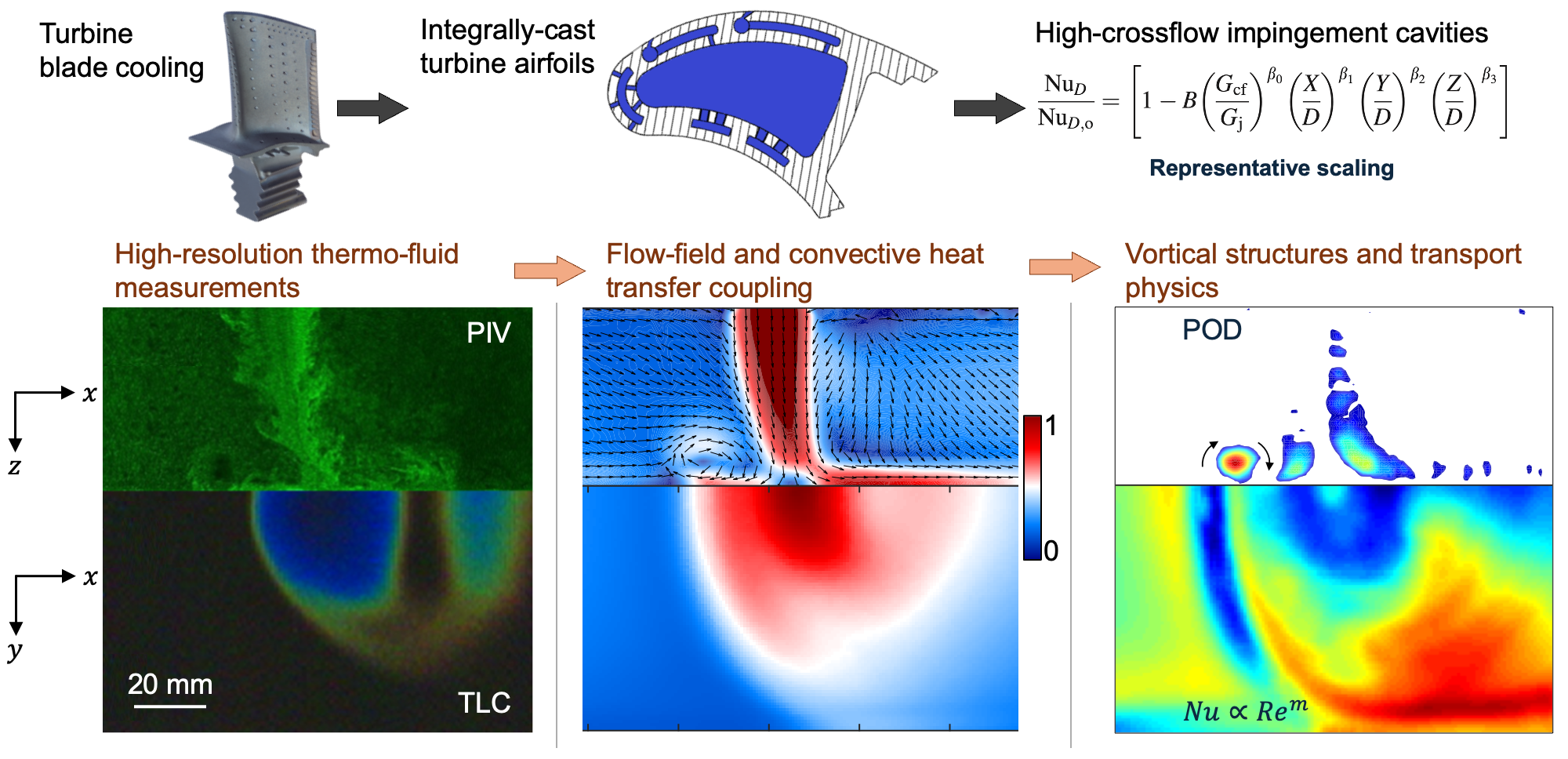
We investigate confined jet-impingement cooling in wall-integrated, double-wall architectures, focusing on how crossflow, geometric confinement, and coolant properties govern local heat transfer distributions. To achieve this, we employ transient liquid-crystal thermography and PIV to resolve full-field heat-transfer distributions and jet–crossflow interactions, while systematic variations in channel geometry, jet diameter, and hole number identify strategies to regulate spent-flow and improve thermal performance. Our experiments directly connect near-wall flow structures and velocity fluctuations to convective heat-transfer augmentation, providing high-resolution data and scaling frameworks for predictive thermal design. Recent multi-gas experiments extend this approach to transport-property effects, revealing the applicability, and limits, of Reynolds–Prandtl similarity in confined flows relevant to turbine cooling and high-heat-flux energy systems.
Flow conditioning for compact and energy-efficient thermal management
We study how flow conditioning and aerodynamic design can improve the efficiency and spatial control of forced-convection cooling systems. Experiments with compact axial-flow devices combine aerodynamic performance measurements with full-field liquid-crystal thermography to connect fan architecture, downstream flow structure, pressure generation, and surface heat transfer. Complementary studies of swirling and counter-rotating jets examine how controlled vorticity modifies jet trajectories, coherent structures, wall interaction, and thermal transport. These studies provide a basis for designing compact air-moving systems that balance cooling performance with pumping-power requirements for energy systems, power electronics, and other space-constrained thermal-management applications.