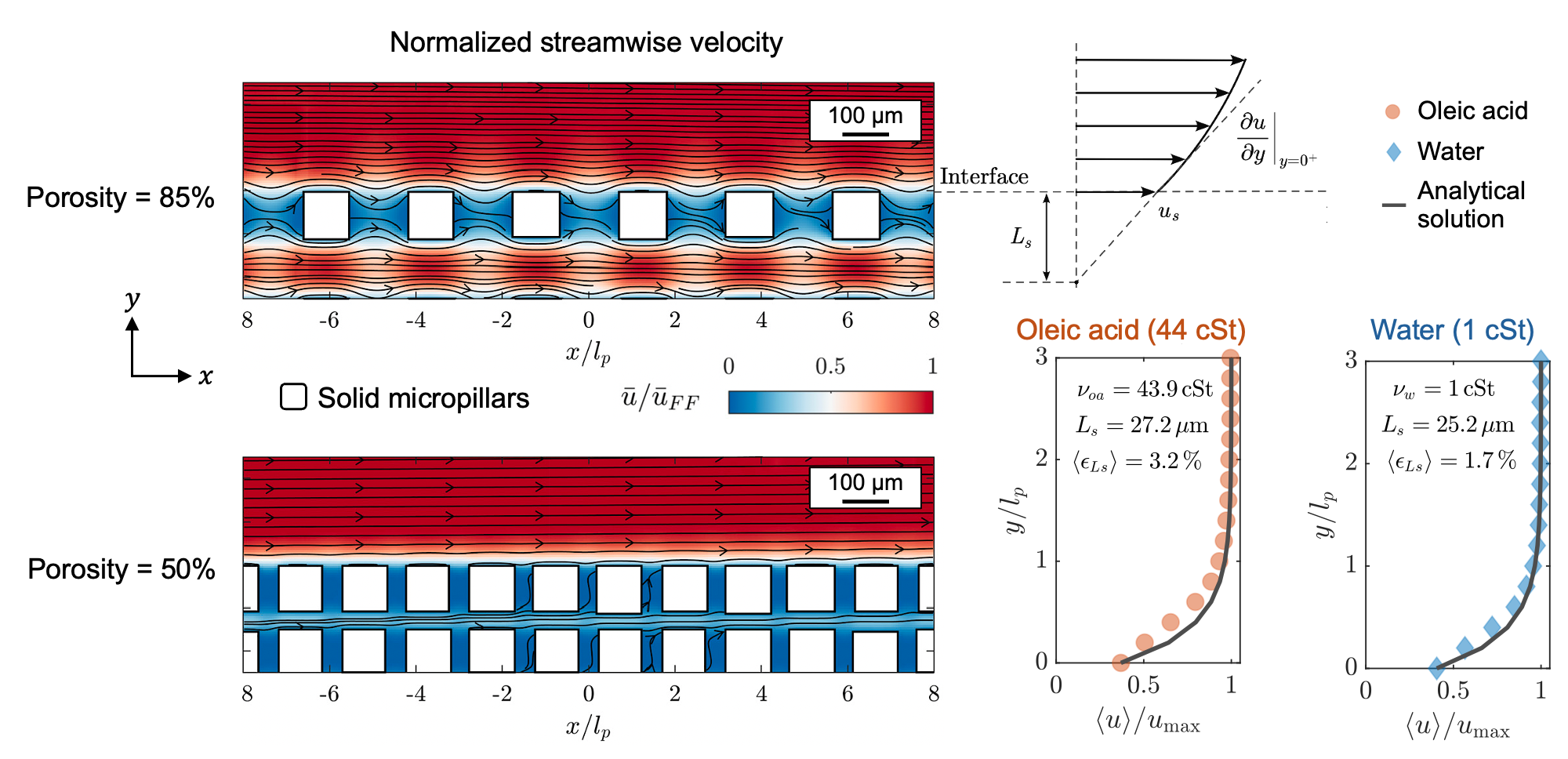
Free-flow and porous media coupling
We investigate momentum transport across free-flow/porous-media interfaces through integrated experimental and theoretical approaches. High-resolution micro-PIV in microfabricated Hele–Shaw micromodels resolves pore-scale velocity fields, interfacial slip, and boundary-layer development, while analytical Darcy–Brinkman models and pore-resolved simulations connect these observations to permeability, porosity, pore geometry, flow regime, and fluid rheology. Our work establishes experimentally validated descriptions of interfacial transport, including permeability-dependent boundary layers, geometry-controlled and viscosity-invariant slip behavior, and exact analytical solutions for confined flows. Complementary numerical studies extend these insights to non-Newtonian and turbulent regimes, supporting predictive upscaling of coupled free-flow/porous transport.
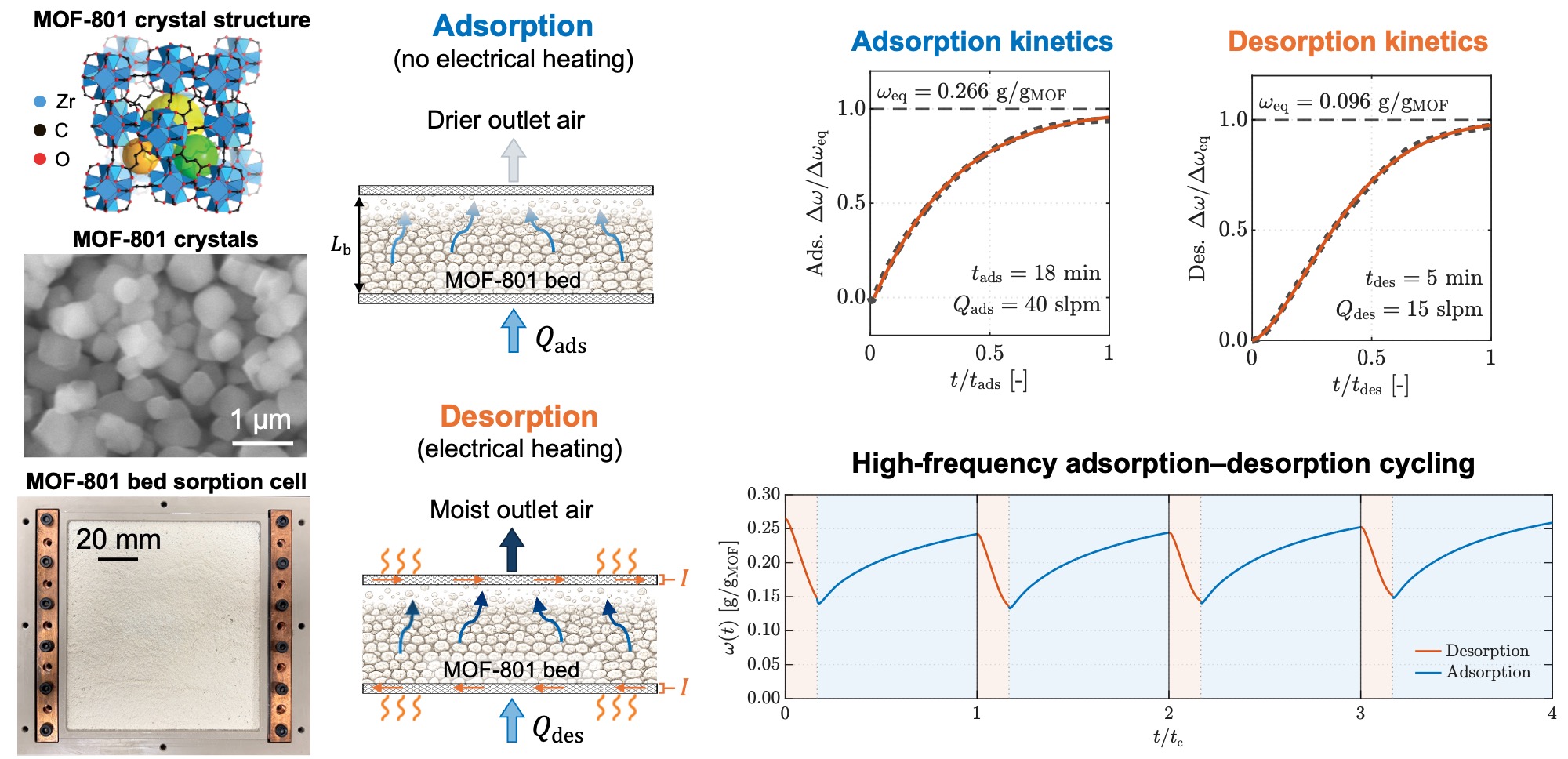
Heat and mass transport in scalable MOF sorption systems
We investigate coupled heat and mass transport in MOF-based sorption systems, with emphasis on translating nanoporous material performance into scalable, energy-efficient devices. Using MOF-801, we develop and experimentally characterize forced-flow architectures—from fluidized beds to shallow, electrically regenerated sorbent layers—to resolve adsorption–desorption kinetics, cyclic water exchange, and thermal regeneration. By linking material uptake with airflow, bed geometry, transport length scales, cycle frequency, and regeneration energy, we identify the transport limits governing sorbent utilization and system productivity. Our work targets high-frequency atmospheric water harvesting while establishing transport principles for thermally driven sorption technologies that can exploit low-grade or waste heat.
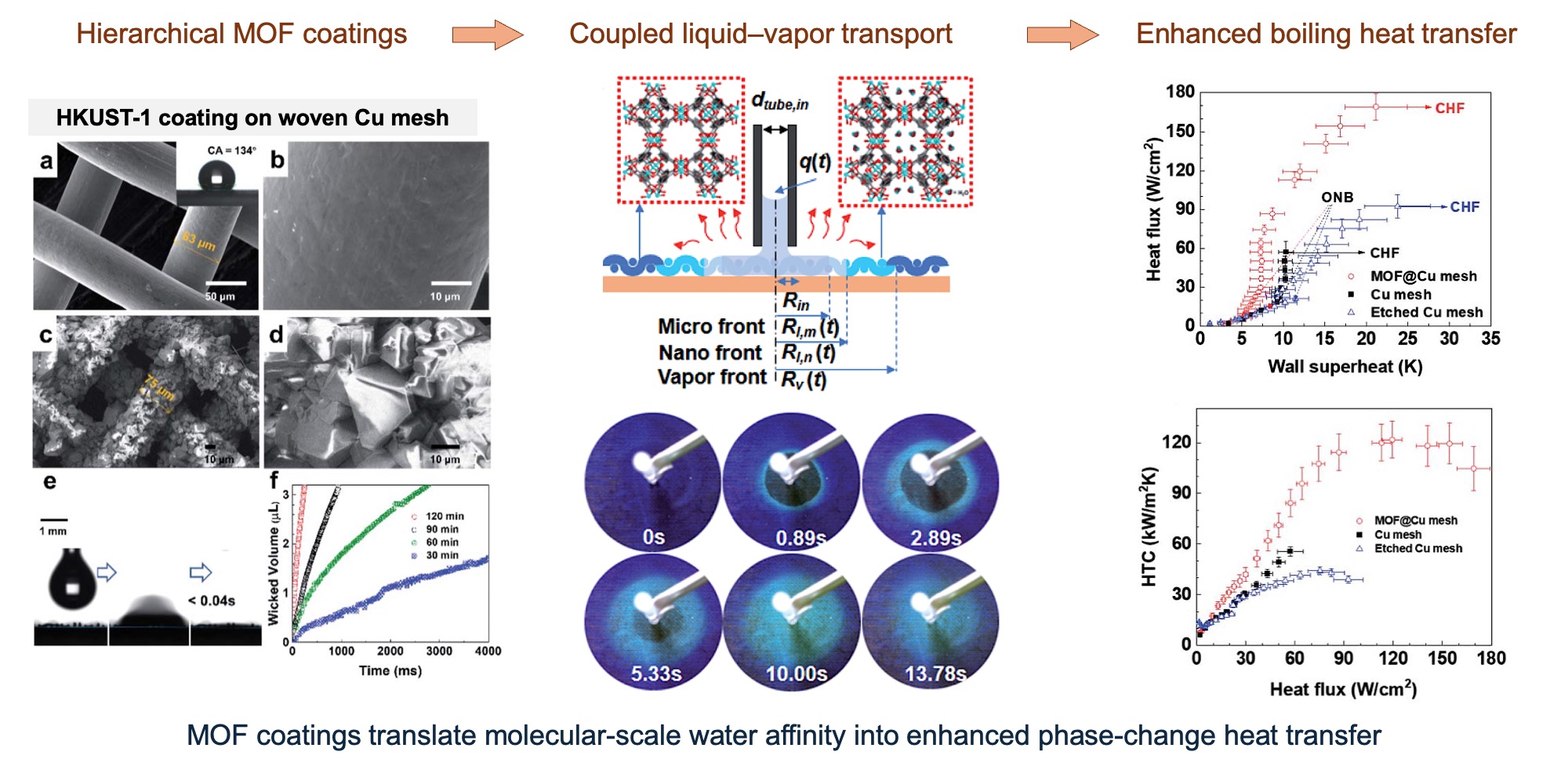
Hierarchical MOF coatings for phase-change heat transfer
We investigate how functional nanoporous MOF coatings can be integrated with microscale porous structures to control coupled liquid, vapor, and heat transport during phase change. Using surface-mounted HKUST-1, we combine molecular-scale water adsorption and nanoscale capillary forces with microscale liquid delivery in hierarchical porous substrates. High-speed and infrared imaging, wicking measurements, and boiling experiments resolve how multiscale wettability and pore architecture govern liquid replenishment, vapor removal, and transient thermal response. These mechanisms substantially enhance boiling performance, demonstrating a route toward passive, high-heat-flux thermal-management surfaces for energy and thermal systems.