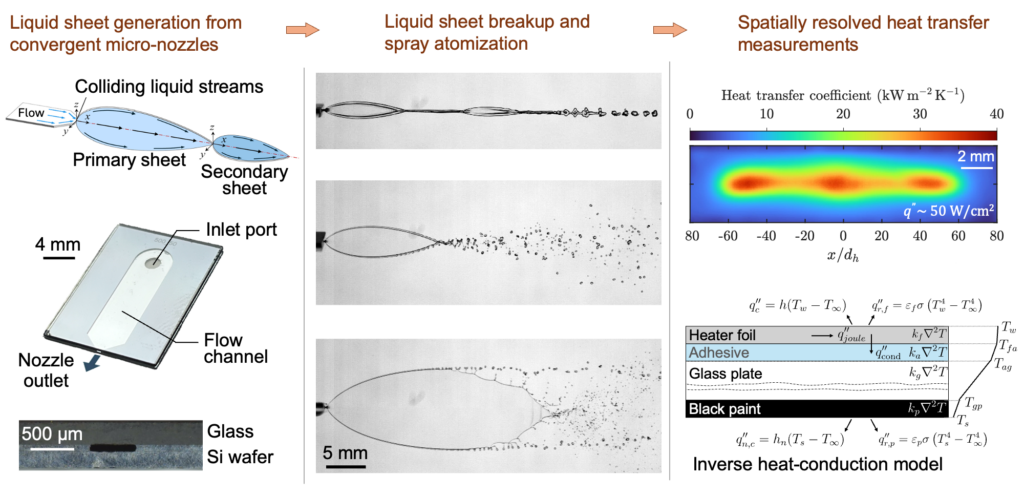
Microfluidic planar sprays for compact thermal management
We develop microfluidic planar sprays for compact, high-heat-flux thermal management, using microfabricated convergent nozzles to generate ultra-thin liquid sheets that controllably atomize into droplets. High-speed imaging, laser-based spray diagnostics, and infrared thermography reveal how nozzle geometry and operating conditions govern sheet formation, breakup, droplet distributions, and spatial heat transfer. Experimentally derived scaling laws connect these processes from nozzle-scale fluid dynamics to surface cooling, providing predictive design tools for compact and energy-efficient thermal-management technologies in energy conversion, power systems, and other space-constrained applications.
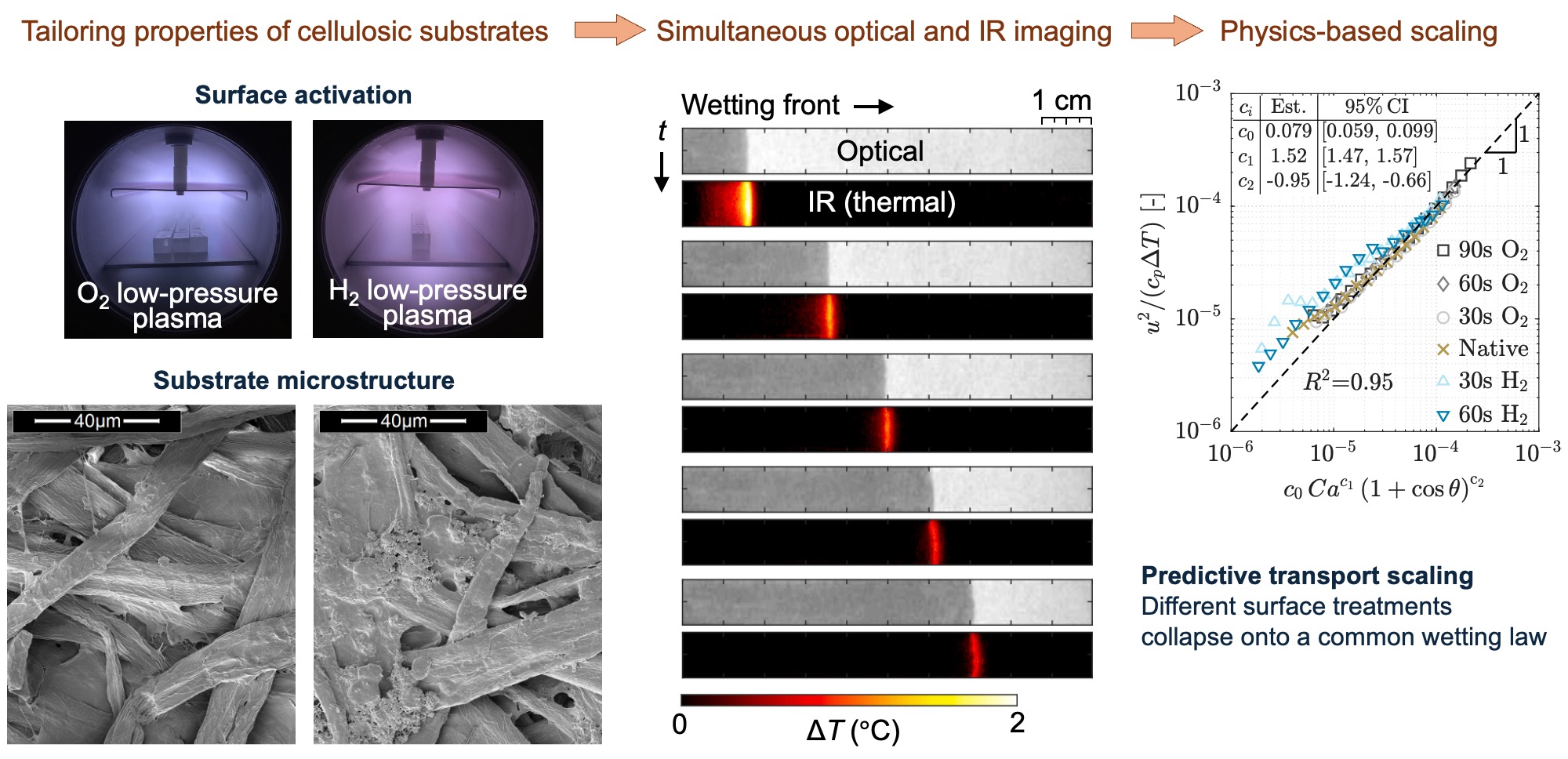
Capillary transport and interfacial thermodynamics in functional cellulosic materials
We investigate capillary-driven transport and interfacial energy conversion in functional cellulosic materials, linking surface chemistry and wettability to macroscopic liquid propagation. Simultaneous optical and infrared imaging reveals a localized thermal signature that travels with the advancing wetting front and reflects the energetic interactions between the liquid and fiber surfaces. By selectively tuning cellulose surface properties through plasma activation, while preserving the bulk porous structure, we isolate the role of wettability in Lucas–Washburn transport. Physics-based scaling collapses the coupled thermal and dynamic response onto a common predictive framework, enabling the design of passive liquid-transport and thermographically readable porous materials.
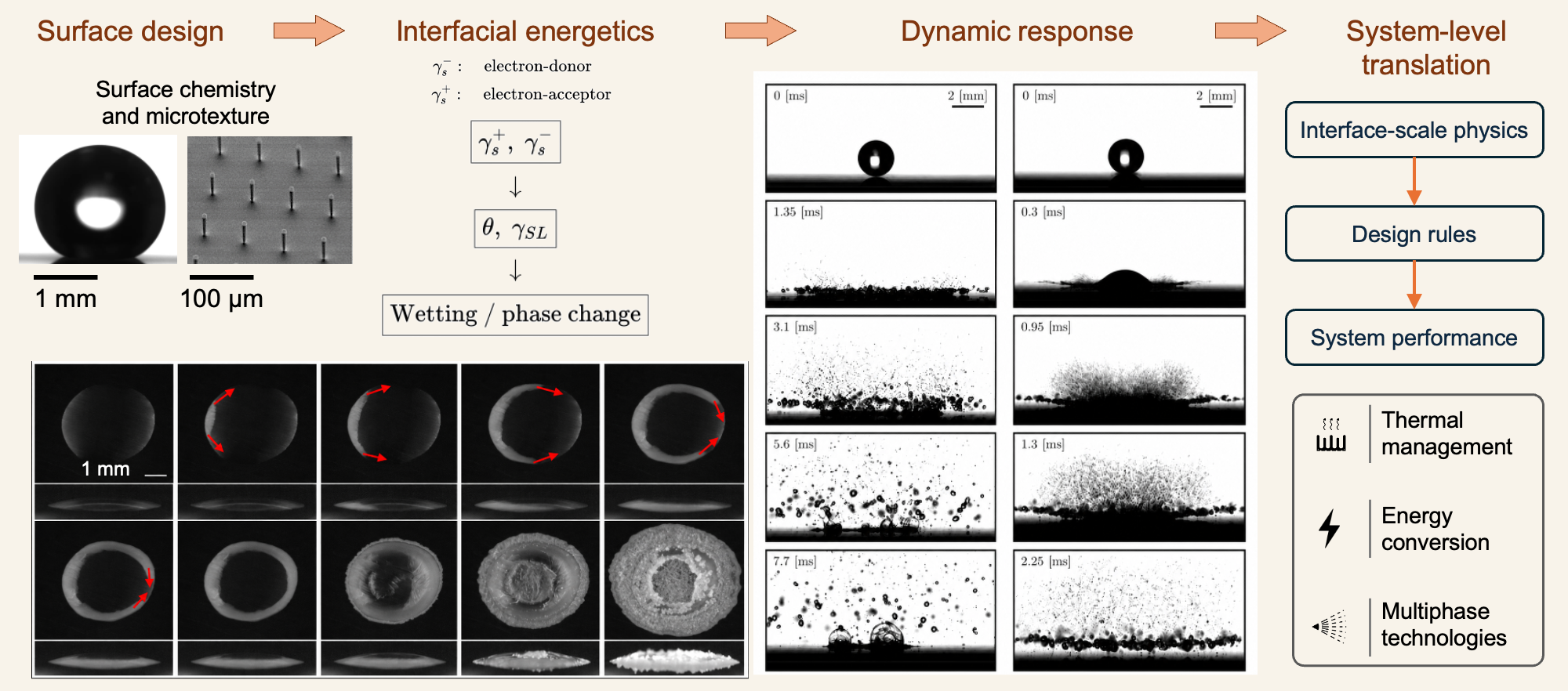
Dynamic wetting and interfacial phase change on engineered surfaces
We investigate how surface chemistry, wettability, and confinement govern droplet transport and phase-change dynamics at fluid–solid interfaces. High-speed and infrared imaging, micro-PIV, and interfacial characterization resolve contact-line motion, internal circulation, droplet impact and splashing, evaporation, and crystallization. Complementary theoretical and numerical models connect these observations to surface energetics, capillarity, inertia, and viscous transport, enabling predictive descriptions of interfacial dynamics across scales. This work provides a physics-based framework for engineering interfaces for thermal management, energy conversion, and multiphase process technologies.